60% FDI exceeds discharge regulations
Many experts warn, FDI into Vietnam from the areas of high pollution risk as textile, footwear, iron and steel.
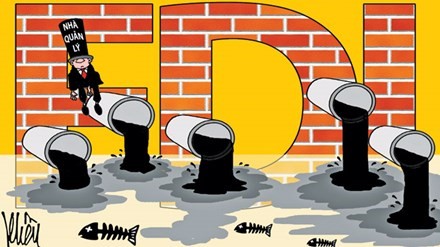
Illustration: Kheu
At the end of last April, the people of Phu Khanh (Ninh Binh) front company focused Chia Chen (DN 100% FDI in Taiwan, specializing in producing metal items) prevents workers, to reflect the company discharged into the environment. The reason: each company waste water from overflowing Air channels, canals surrounded the capital of Phu Hao Village, Phu Khanh commune, fish immediately made of white dead people. Even drinking water buffaloes also died (typically the service of his family dead cow Phan Van Huong).
Exhaust gas valve concentration anonymously
Presence at the point of discharge at the end of the month 5/2016, as observed by PV Pioneers, from the company Chia Chen has a large sewer lines buried underground canals connecting to the Air. At discharge manhole, the water shut stained yellow scum, grease emerging and foul smell concentration anonymously.
Additionally, each cluster hyacinth chlorosis yellowing and dying down. Canal, close to Phu Hao village only about hundred meters up the smell concentration rises, blowing straight into the village of about 375 living that households with 1,450 inhabitants turned upside down. Mr. Zhang Hong Phu - Phu Hao village head said: "Since the company Chia Chen went into operation, the life of people in the affected villages continuously. Company sneaky discharge canal many times. We propose uphill but did not receive a satisfactory answer. "
"There are 60% of total FDI enterprises exceeding discharge standards. Of which 23% exceeds FDI enterprises discharge regulations allow 5 to 12 times. Nearly 70% said FDI enterprises to invest in Vietnam will save costs on the investment environment in the country than them. "
Research group National Economics University
Company Chia Chen is just one of the environmental pollution FDI enterprises in Vietnam. Most recently, on 5/10/2016, an interdisciplinary working group of Ba Ria - Vung Tau's dyeing factory sealed Ltd. Mei Sheng Textiles Vietnam. Although not licensed, but the company voluntarily doing workshops dyeing capacity of 1,100 tons / year; drilling 26 wells arbitrarily; illegally harvested more than 2,700 m3 of water per day underground and illegal discharge. Notably, this is the 7th seal to this company since it was licensed.
Earlier, in 2008, Vedan Vietnam discharged, polluting the Thi Vai River (Dong Nai). With the discharge of 100,000 m3 underground toxic waste water into rivers each month. radius to 10km wide pollution along the Thi Vai River, Vedan has nearly 2,700 damaged aquaculture ha of Dong Nai, HCM City and Ba Ria - Vung Tau.
Then in 2014, the Provincial Committee of Ba Ria - Vung Tau suspension issued directives to attract investment in 8 areas including steel production because of pollution fears. Dynamics of Ba Ria - Vung Tau is the alarm bells for many localities in attracting FDI projects.
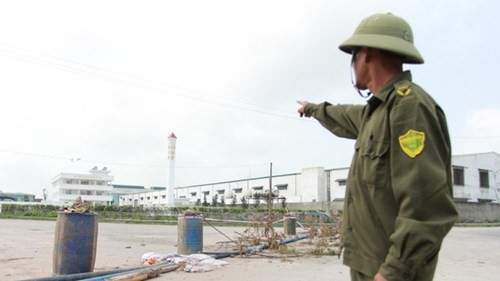
Company Chia Chen discharge pollutants making people's lives upside down.
Evaluation studies on the policy compliance of environmental protection legislation by the University of National Economics 2015 implementation has announced recently showed that 60% of the total number of FDI enterprises exceeding discharge standards. Of these, 23% FDI enterprises exceeded discharge regulations allow 5 to 12 times.
FDI associated risk of contamination?
And almost 70% said FDI enterprises to invest in Vietnam will save environmental costs from 10 to 50% costs compared with their overseas investments. May 4/2016, Institute for Economic Management Central (CIEM) has also published research on environmental impact of FDI in Vietnam. At this announcement, representatives CIEM warning: More signs of FDI in the field of environmental polluters to invest in Vietnam.
Back story Company Chia Chen, Mr. Hoang Duc Long, director of Ninh Binh Industrial Zone Management Board, said waste water is leading to fish kills of Industrial Co., Ltd. Chia Chen. Interdisciplinary inspection team Ninh Binh province has wastewater sampling test, but so far has not announced the results.
At a workshop on investment shift took place recently, by the Centre for Human and Nature, of the Union of Vietnam Science and Technology, commented on the story shifting investment capital, recently, she Tran Thanh Thuy, head of the central policy of this comment: the trade agreements that Vietnam has signed recently led to the shift of investment flows for some pollution industries in Vietnam. Processing industries most polluting includes textile, footwear, seafood, steel ... Ms. Thuy for example, statistics from the Department of Planning and Investment Nam Dinh province, province 2015 attracted about 190 million USD. But nearly 90% of registered investment projects from Chinese textile industry, Korea ...
Also at the conference, Mr. Do Thanh Bai (Vietnam Chemical Society) analysis, the textile sector is attracting investment in Vietnam because many take advantage of labor. But investors often look to the textile industry to evade the problem of wastewater treatment.
Dr. Le Dang Doanh, then shared at the seminar: foreign investors in Vietnam due to want maximum profits. Therefore if we are serious, forcing them to protect the environment. Song stitch monitor our environment loose.
"Vietnam is not an industrialized country but the issue of environmental pollution was very serious. That pollution increases, entail costs solve major social problems. Every year, Vietnam damage caused by environmental pollution equivalent to 2.5% of GDP. And this figure is 6.5% of China. If the momentum of environmental pollution as now, was going to catch up with China, "he said Doanh.
As a leader MPI, most decentralized projects on local investment. With large projects, MPI only aggregate functions is to report to the government sector. As the expert appraisal of investment, he said, should not take the trade-environment for economic development projects. Though not dare waste industry to ensure absolute cleanliness, but must be dealt with in the limit allowed before discharging it into the environment. According to him, the investment must be strictly controlled to avoid the risk of contamination.
According to Tien Phong

.jpg)